
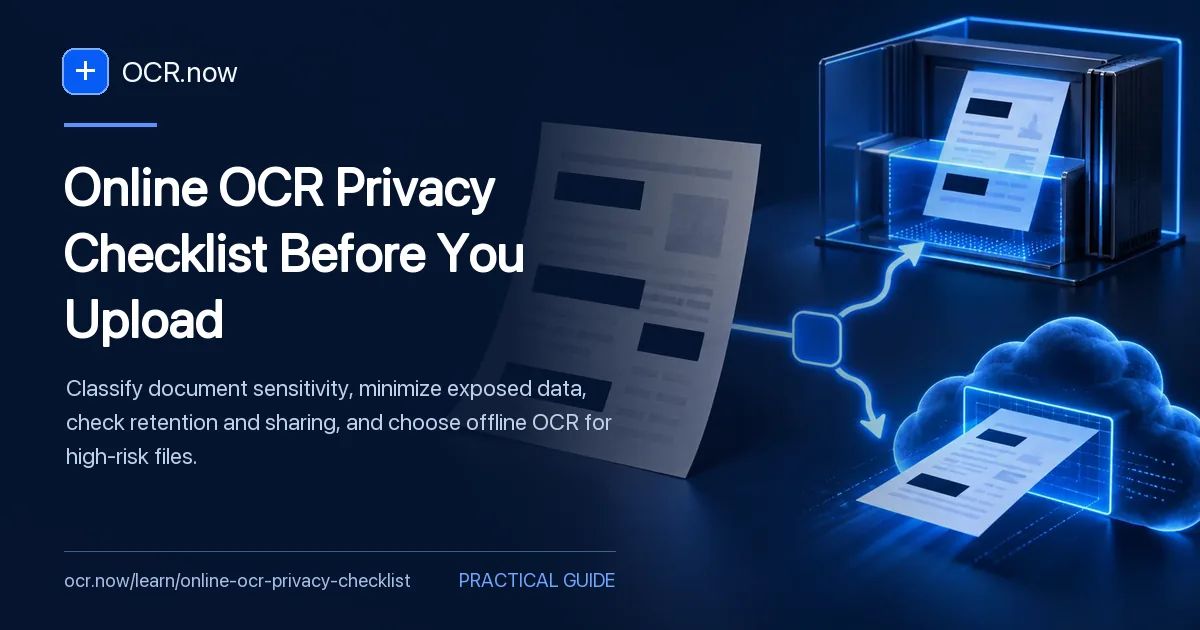
Decide whether the document belongs in an online service first
Before uploading, decide whether the document belongs in an online service at all. Convenience does not override duties to the people named in the file.
The intended outcome is an upload decision based on authorization, sensitivity, minimization, retention, sharing, and possible harm, including a clear choice to use an approved offline process when needed.
If online processing remains appropriate, minimize the source before using Image to Text. Continue with OCR vs Manual Transcription: A Risk-Based Choice and Form OCR: Checkboxes, Blank Fields and Repeated Labels.
For retention, minimization, and offline-processing decisions, continue through the online OCR privacy and safety collection.
Upload decision
| Document condition | Online OCR response | Reason |
|---|---|---|
| Public, low-risk page | Proceed after normal review | Limited exposure |
| Unneeded personal fields | Redact pixels before upload | Data minimization |
| Regulated or confidential record | Use approved workflow | Policy and legal obligations |
| Unknown service handling | Do not upload | Risk cannot be assessed |
Create the smallest defensible upload
A six-page form may require recognition of one public instruction paragraph. Duplicate the source, remove unrelated pages, crop to the needed region, and flatten any true redaction. Reopen the derivative to confirm that covered pixels, hidden layers, metadata, and extra pages are not recoverable.
Then confirm authority, purpose, retention, deletion, sharing, and subprocessors. If the document contains identity numbers, health or financial data, credentials, legal privilege, children's data, or another person's confidential information, convenience is not enough. Use an approved offline or organizational process when the consequence cannot be justified.
- Minimize before upload
- Verify redaction rather than trusting its appearance
- Stop when handling terms or authority are unclear
Stop-and-check questions before uploading
- Identify people and sensitive fields
- Confirm authority and purpose
- Minimize pages and regions
- Verify retention and subprocessors
- Prefer offline processing for high-risk material
Reduce exposure before any upload
Classify the document
Look for identity numbers, financial or health data, legal privilege, credentials, children's data, trade secrets, and information belonging to other people.
Minimize the source
Crop unrelated pages and redact fields that are not needed. Confirm redaction removes pixels rather than placing a reversible shape on top.
Check operational claims
Read retention, deletion, subprocessors, transport security, account controls, and sharing settings. A short privacy slogan is not a data-processing agreement.
Prefer offline for high risk
Use approved organizational or offline tools when contractual, legal, regulatory, or safety consequences make third-party upload inappropriate.
This is not legal or security approval
The checklist cannot decide whether a particular upload is lawful, contractually allowed, or safe for an organization. Data classification and authorization must come from the responsible owner.
How to read provider and policy sources
First-party policies describe stated handling; independent standards describe control expectations. Verify current terms, retention, subprocessors, and organizational requirements before relying on either.